

General Tourist Information

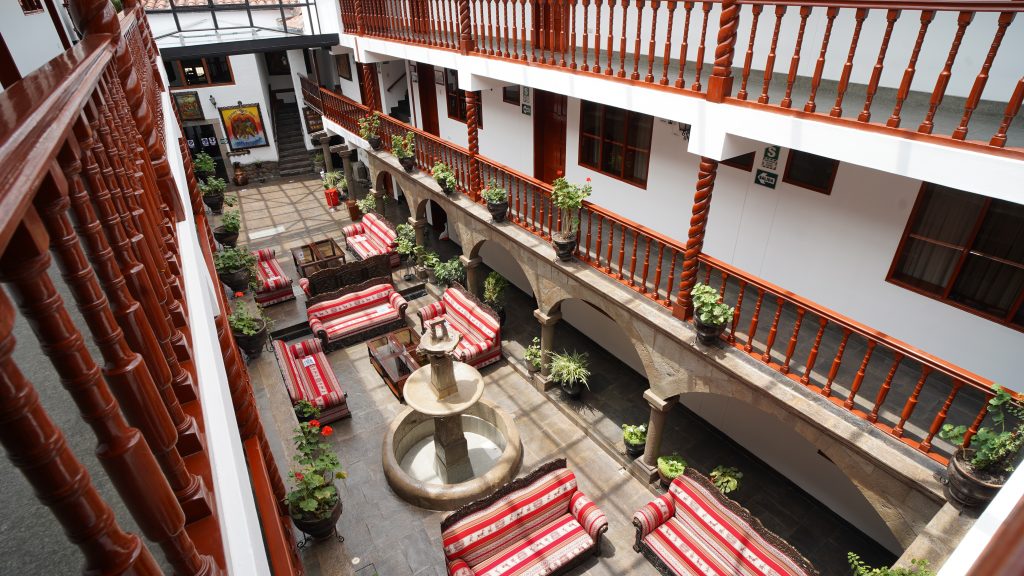
Munay Wasi Inn Hotel *** Click to enlargeTourist activity in Cusco is of a colorful and festive nature, expressed in the form of a seemingly infinite variety and diversity of ways and customs, dress and attire, dance, song and rituals. Cusco is one of the principal cities of Peru and was once the nerve center of the great Inka Empire. It is also a site of remarkable natural splendor.

As such, it offers the visitor beautiful landscapes and scenery as well as a key point of reference and link to the magnificence of the Inka Culture.

Yet there is more to Cusco than the monumental architecture of a bygone era and the ever present grandeur of the Andes Mountains. The true essence of Cusco lies in its people, their character and their customs.

Cusco is –and shall forever remain- above all, a Cultural Capital of the New World. Cusco is history, tradition and reality: a virtually mandatory destination for those folks who are enamored and somehow devoted to the history of humankind.

BASIC FACTS & FIGURES

Location: The Department of Cusco is situated in the southeastern region of Perú
Area: 71,891 Km2
Departmental Capital: The City of Cusco
Altitude: 3,395 Meters Above Sea Level
Mean Yearly Temperature: 11°C
Maximum High: 17°C
Maximum Low: -2°C
Rainy Season: November to March

ACCESS

By Land: The most recommended terrestrial access route is via Lima-Arequipa-Cusco ; covering a distance of 1,494 Km. by road and comprising 24 hours of travel.

By Rail: There is a Railroad Service lining Cusco with the cities of Puno and Arequipa. The Arequipa-Juliaca-Puno-Cusco route is 735 Km. long and has a duration of approximately 23 hours.

By Air: There are a number of daily flights from Lima to Cusco. Average time of flight is 55 minutes.

Principal Tourist Attractions and Features of Interest In Cusco

Cusco was regarded as the "Navel" or "Center of the World" in ancient times and, effectively, constituted one of the greatest and largest –as well as most populated- cities in the world as late as the beginning of the 16th century. It practically surpassed all the European capital cities of those times -such as London, Paris, Lisbon and Milan- in extension and opulence. The European invasion and conquest which took place in the 1530's brought with it a substantial amount of material plunder and destruction –as well as the virtual obliteration of the indigenous culture. However so, the invaders and despoilers, -motivated as they were by essentially materialistic causes and aims- could not but realize and understand the inherent worth and value in the great architectural structures and monuments of the Imperial Capital. Due to this fact, an appreciable number of these buildings survived total destruction and demolition. In turn, nevertheless, many lost their former "identities" and became the foundations for the Churches, Temples and Mansions of the Conquerors –most of which, with the passage of the centuries, were in themselves to become great "Colonial" architectural monuments. Yet other pre-Columbian constructions and monumental works of art served no immediate practical function other than to provide a source of building materials; and a few –by reason of the peculiarity of their makeup, such as enormous carved rock outcroppings and equally huge quarried and dressed ashlars weighing many tons- escaped any attempt or concept of usefulness and were thus left as and where they stood: unscathed, untouched and mostly unknown until present times.

The following represents an overview of only some of the more unique architectural, monumental and artistic features and sites of interest that are to be found in this which very probably constitutes the oldest continuously inhabited city in the Western Hemisphere and its surrounding areas.

The Cathedral of Cusco

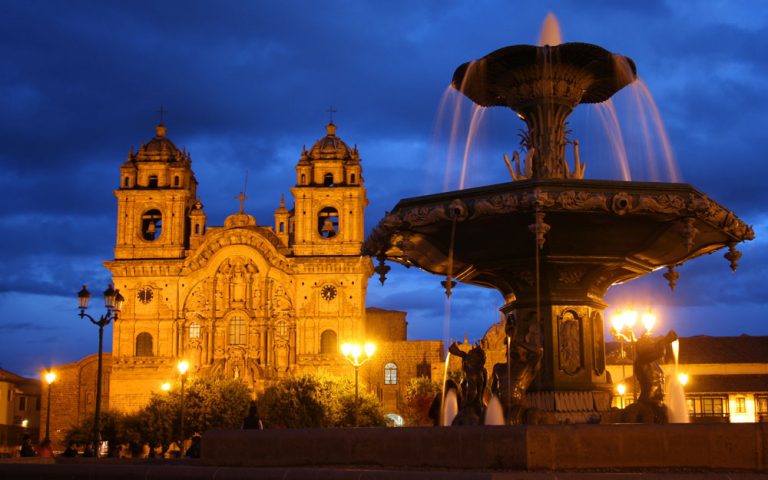
Once was the ancient Temple of Suntur Wasi (The Dwelling of God) was originally built by the Spaniards as a small Chapel (known today as the Capilla del Triunfo) annexed to the palace of the Inka Wiracocha. Atop this latter and larger structure was erected the present Basilica Cathedral of Cusco. The façade and nave are of renaissance style. The latter is extensively decorated with woodcarvings in cedar and alder. Particularly outstanding are the early 17th century carvings wrought by the native artists Martín Torres and Melchor Huamán. The choir stalls, pulpit, various altars and furnishings represent a high water mark of the indigenous mestizo colonial art of Cusco. There are likewise a myriad constellation of oil paintings constituting one of the greatest collections of 17th century native American colonial religious art and countless other works of art by gold and silversmiths in embossed silver and precious metals.

The Korikancha

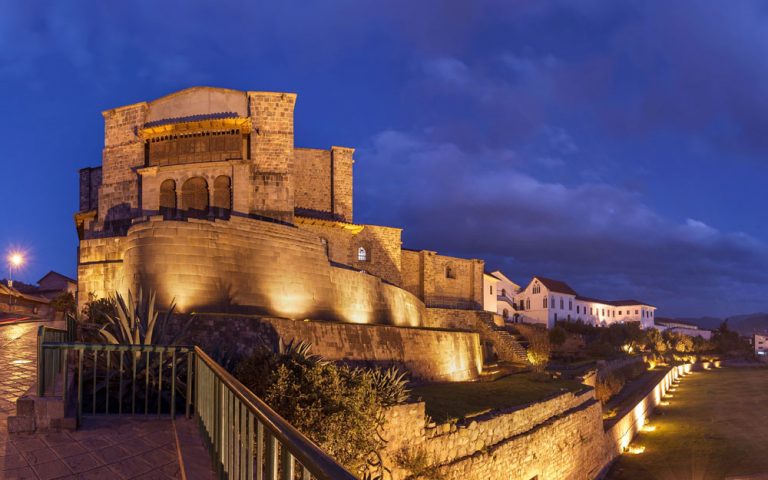
This is a Spanish construction, built as a Dominican Convent and Church atop the original Inka Temple of the Sun, utilizing native slave labor. In the Indigenous Quechua language spoken at the time of the Inkas (and in present times by over 10,000,000.- people) Korikancha signifies "the Enclosure of the Sun" and, as such, constituted the main Religious Edifice and Structure built by the Inkas to worship the Sun. According to the original Spanish Chroniclers, the inner walls were covered with plates of gold. Some of the finest masonry ever created can –to this day- be viewed and appreciated in this particular site.

Sites and Areas Located in the Immediate Vicinity of the City

Sacsayhuaman

Located 2 kilometers from the center of town -10 minutes by car and 25 minutes on foot- some 200 meters above the city lies the "fortress" of Sacsayhuaman. This represents the maximum exponent of the so-called "cyclopean" architectural style, with huge blocks of quarried and dressed stone, some of them over 6 meters high and weighing several hundred tons. Considered as a fortress by the first Spanish chroniclers due to the role it played in the wars between Inka and Spaniards, it was in all probability originally another great worship site, possibly dedicated to the thunder and lightning bolt. It is surrounded by numerous other smaller sites of eminently religious nature. The archaeological structure itself is composed of three tiered levels of "cyclopean" masonry set in a zig-zag pattern one above the other and roughly 360 meters long. Originally, three towers, the foundations of which can still be seen, rose at the topmost level, but these were destroyed at the time of the conquest. The three levels are interconnected by means of stairways and portals. One of these is 9 meters high and 5 meters wide.

Kenko

Located 3 kilometers from the center of Cusco and about 1 kilometer from Sacsayhuaman. It is thought to have been a religious shrine and worship site. it consists of a large sedimentary rock outcropping with numerous labyrinths and passageways tunneled through it as well as countless carvings of zoomorphic and abstract designs. There is a large monolith bearing a resemblance to a Puma (albeit defaced, probably during the conquest period), as well as numerous platforms and solar gnomons.

Tambomachay

Situated 7 kilometers from the city center and on the same plateau above the city that includes Sacsayhuaman and Kenko. It is alternatively denominated as the "Baths of the Inca" due to its constantly flowing streams of spring water channeled through superbly carved conduits set amidst some of the finest examples of Inka polygonal masonry known. It is considered to have been a religious shrine devoted to the cult and worship of water.

Sites and Areas Located Beyond the Immediate Vicinity of the City

The Sacred Valley of the Inkas and the Inka Trail to Machu Picchu

The "Sacred Valley of the Inkas" is the popular name for the valley and later gorge carved by the Vilcanota River –as it changes into the Urubamba River- through the Eastern Andes in the course of its northward flow into the Amazon watershed. This corridor from highlands to jungle was extensively utilized for commercial, political and military purposes by the Inkas. They built and/or developed a chain of fortified cities and administrative outposts all along this valley, which culminated in Machu Picchu, already placed well within the forested regions. There exist numerous archaeological and historical sites along the 80-100 odd kilometers that the Vilcanota-Urubamba discourses through the final stretch of the eastern Andes before they give way to the Amazon mid- and lowlands; yet three principal sites appear to hold sway over all others and are the most noteworthy of mention:

Pisac: This is a Spanish Colonial village situated on the right bank of the Vilcanota River. It is 30 kilometers distant from Cusco or the equivalent of a one hour car ride on a paved highway. It is known for its "Indian Market", in which groups from all the surrounding highland villages congregate weekly to trade and barter their produce; exceptional samples of local handy craft and folk art can be obtained. But Pisac is renowned for the impressive archaeological remains of the Inca city that are spread over the mountain looming several hundred meters above it. These consist of finely built edifices, an astronomical observatory, an extremely sophisticated irrigation system and enormous agricultural terraces that continue to be used by the local communities centuries after they were constructed.

Ollantaytambo: Properly speaking, this an Archaeological Park located some 80 kilometers or about two hours' car ride from Cusco, comprising numerous archaeological sites on both banks of the Vilcanota-Urubamba river and closely linked to Machu Picchu which lies only 35 kilometers downstream. But the hub and "metropolitan center" of the area is the pre-Columbian city of Ollantaytambo. This was another great Inka city, with impressive cyclopean masonry and strong indications suggestive of an earlier , pre-Inka (perhaps Tiahuanaco) origin. The surrounding areas and local administrative units are eminently agricultural in nature characterizing it as one of the great and timeless "breadbasket" regions of the circum-Cusco territory.

Machu Picchu: Located 112 kilometers northeast of Cusco, this site is yet another major hub and Inka administrative center. Strategically situated on a ridge between two mountains –Machu Picchu (Old Mountain) and Huayna Picchu (Young Mountain)- already within the mid-highland jungle cloud forested region endowed with a great abundance of flora and fauna, the citadel of "Machu Picchu", when uncovered in the year 1911, was assumed to have been an isolated sanctuary. Focalized archaeological research has since revealed several concentrically disposed urban and suburban archaeological sites and areas of agricultural terracing indicating evincing substantial human occupation and activity in the area, in some cases extending itself into as of yet undetermined sectors of surrounding lowland jungle regions.

ECO AMAZONIA LODGE:

Few are those places in the world in which nature has displayed itself so magically splendorous and abundant as in Amazonian Jungle of Peru: a vast concert of vibrant rainforests, mighty and impetuous deep-flowing rivers, immense swamps and marshlands known as “aguajales” … all of them conforming an exuberant ecosystem where life is manifest in virtually every form.

In this wondrous realm -comprising an area of 10,000 hectares (approx. 25,000 acres) in extension and within the region known as Tambopata, at a point situated only 30 kilometers (approx. 19 miles) down the Madre de Dios river- is located the EcoAmazonía Lodge and Ecological Nature Reserve.

Ecoamazonia Lodge invites you to participate in a spectacular journey that will overwhelm your senses, whilst simultaneously contributing to the effort of ensuring the survival of this splendid nature reserve through the means provided by sustainable Eco-Tourism. Engross and, indeed, lose yourself in the midst of this wonderland:

Observe the joyfully boisterous flocks of parrots and the more than 1200 species of birds, delight your eyes and mind revering in the admiration of 700 types of butterflies, interact with hundreds of animal species that have sought and found shelter within the heart of the Amazonian forest. Do not hesitate nor give it second-thoughts: extricate yourself far from the world of noise and crowds - immerse your body, mind and soul into the deep heart of the Amazon jungle to become one again with the essence of nature.

EcoAmazonía Lodge: Lies situated within the nucleus of the Tambopata Nature Reserve. It is a marvelous site, laid out with bungalows of characteristically typical local design and architecture, each of these with a porch, bathroom, hammocks … there are also a main reception, a dining room, a barroom with games and amusements, a separate venue suitable for ecological and study purposes, and an ecological swimming pool. A stupendous place to stay in. Likewise, guests will find available a variety of tours conducted by local guides who are charged with the mission of providing you with the opportunity of experiencing real adventure in the true natural jungle, whilst being attentive and dedicated to your safekeeping as well the pleasure and satisfaction of your stay. So, do please come and enjoy to your utmost this Amazonian paradise.

TOURS generally take place during the early morning. In the course of the afternoon, optional family visits to the botanical gardens and eco-swimming pool are available to guests and are free of any additional charge.

Weather : Tropical to sub-tropical rainy.
Humidity : Maximum 93%
Temperature : High of 40°C (approx. 98°F.); Low of 27°C (approx. 75°F).
Solar Radiation : Variable
Altitude : 200 Mt. (approx. 600 Ft.) above sea level

SERVICES

The facilities we offer are built of rustic material from the area. There a total of 45 rooms and comfortable ecological bungalows. The environment of each room is properly furnished with screens to keep insects out; a room with comfortable hammocks and the bedroom has two beds and a private bathroom. We have a reception to welcome to you, an ample dinning room, a bar where exotic drinks are prepared by our bartender, a library and a living room for esoteric sessions.

TRANSPORT

The Lodge uses only properly equipped safari buses, with capacity for 25 passengers, to transfer them from/to the Puerto Maldonado airport. We also posses our own motor boats for smooth and swift trips down the Madre de Dios River to the Lodge.

MEALS

Our chefs prepare traditional rainforest and other dishes typical of the region, such as Juanes (a version of Tamales), a meal symbolizing the annual harvest; as well as Paca (a large rodent of the Guinea Pig type), Palmito (Palm Hearts), and savoury dishes of fish from the surrounding rivers, such as Dorado, Doncella, Salton. Our chefs are also specialized in vegetarian cuisine

The Festivities of Cusco

The City of Cusco celebrates over 350 festivities throughout the year. All of these commemorative events are directly and intimately related both to Christian Religious Holidays, as well as –through the peculiarities and affinities of the religious syncretism so markedly prevalent in the Andes- to traditional pre-contact beliefs and customs. This is particularly manifest in the elaborately costumed dancing and other expressions of the indigenous culture. An element of mystery and deep mysticism always pervades these events and is clearly felt by all present, foreign and national alike.

The following are the principal festivities which take place in Cusco and the time of year when they are held.

January: Exhibitions of nativity scenes take place in many of the local homes and churches. On January 6th is held the celebration of the Epiphany, commemorating the coming of the Magi or "Three Wise Men of the East". Locally known as "Bajada de Reyes", this constitutes a major religious festivity in the village of Ollantaytambo,

February: Carnival, characterized by the richness and variety of dances and the profusion of games and mock battles with water, talcum powder, confetti, etc.

March: The celebration of the Holy Week. This major religious festivity is of particular importance in Cuscoand much of it is focused upon Holy Monday when the procession of the Señor de Los Temblores (sworn Patron Saint of the City) takes place. Much of the local population turns out for the occasion, in order to receive the blessing of the Lord.

May: The Vigil of the Christian Crosses (Cruz Velacuy) and The Festival of Qoyllurit'y. This last is originally an Andean pre-Columbian and pre-Christian festivity consisting of a pilgrimage to the snow capped range of Sinakhara in the vicinity of the great mountain known as Ausangate, which is considered the tutelar spirit –or "Apu"- of Cusco. the site lies about 100 kilometers southeast of Cusco. Once there, several days of dance and song take place, in which Pagan and Christian rituals take place in what is clearly a syncretistic expression of mountain worship.

June: The celebration of Corpus Christi. This constitutes the largest and most important of all the religious festivities of Cusco. There is a solemn procession of the Monstrance and the venerated images of the 17 Patron Saints of the various neighborhoods and surrounding towns and villages. Many of the images are over 400 years old and are carried on biers by the local inhabitants in some cases from many kilometers away. there are numerous musical bands, much singing, dancing, eating and drinking.

July: This is the month of the traditional celebration of the festivity of la Virgen del Carmen, which takes place from July 15th until July 17th in the town of Paucartambo. The highlight of the festivity takes place on July 16th, the official Church calendar Anniversary of the Virgin. This is another syncretistic example of Andean-Christian fusion, surrounded by great pageantry and folkloric expression. There is a traditional presentation of 16 folkloric dances performed by specific dance troupes. A parallel festivity in honor of the Virgen del Carmen takes place in the town of Pisac between July 25th and 29th.

August: The most outstanding festivity of this month is the reenactment of the traditional Inka ceremony of "Warachikuy", which was essentially a puberty rite in pre-conquest times. It marked the moment when the older boys became young men and received their "Wara" (adult breechcloth). The festivity is held on the wide esplanade of Sacsayhuaman and the pageant includes trials of strength, dances, valor and other traditional Inka rituals.

September: On September 14th takes place the festivity of the Señor de Huanca. Similar to the Festivity of Qoyllurit'y, it is a syncretistic expression of worship to the mountain Pachatusan (the pillar of the world) which is the highest immediately surrounding crag to the city of Cusco. Within the "ranking" system that governs the hierarchy of Apus, Pachatusan is considered as "the Son" of the Apu Ausangate.

October: The principal festivity of this month is that celebrating San Francisco, when simultaneous festivals take place in the towns of Tinta, Urcos and Maras.

November: On the first day of this month, All Soul's Day is observed along with the traditional visit to the cemeteries to share time, company food and drink with deceased relatives, friends and foes alike. On the following day –November 2nd- there is the festivity of All Saint's Day. Both of these bear a fascinatingly indigenous flavor in a -literally speaking- culinary sense: for this one occasion, bread loaves are baked with specially chosen representative shapes . There are the "Wawas" ("children", "dolls") shaped in a form not altogether unlike the traditional "Gingerbread Man" of other latitudes, and there are also the "Caballitos" ("ponies") shaped as small horses and bedecked with candied fruit and multicolored beads of confiture. Other culinary specialties of what could be termed as the "Festive Cuisine" of the Cusco Region include much roasted suckling pig and corn tamales.

December: This is a month of great celebration the world over. At this time, the religious and cultural syncretism inherent in humanity reaches one of its ultimate peaks. For not only is it Christmas, but it also marks one of the two annual Solstices (summer solstice in the southern hemisphere and the winter solstice in the northern), observed by folks during thousands of years before the birth of Jesus confirmed the uniqueness of the moment, although the opposite could quite and very easily prove to be the case. But there is no case to be proven, for ultimately -be it as it will- it is the time of coming together for all, to celebrate the renewal of life, the moment when our Flowering Earth begins anew its journey of circumvention around the mother star.

Among the numerous festivities that take place in Cusco on this occasion, there is one that stands out conspicuously; perhaps due to the antiquity of its roots or perhaps because of its unerring as well as paradoxically innovative constancy: the "Santuranticuy". On the morning of December 24th –Christmas Eve- artisans, craftsmen, potters, weavers, painters, woodcarvers, sculptors, masons, carpenters, gilders, highland Indians who have painstakingly gathered mosses, lichens and stones for crèches and nativities, jungle peoples bearing coconuts, dates, fruits, flowers and long stalks of sugarcane –artists one and all who have arrived from every corner of the Empire of the Sun during the previous nights and countless days- spread their blankets out upon the ancient cobble stones of the great square and offer their life's work -the product of their inspiration, the fruit of their ever present ancestral memories - for sale, barter or trade, but above all, as propitiatory offerings to life and the living –all gathered and come together as they have every year for thousands of years in this very center of the navel of the universe.

Hotel Munay Wasi Inn ***
Av. Tullumayo 418
Cusco, Peru
tel.: +51 84 240283 / 231245
fax: +51 84 224312
e-mail: reservas@munaywasi.com

Design by Gissel Enriquez - Development by Jeronimo Design DDS